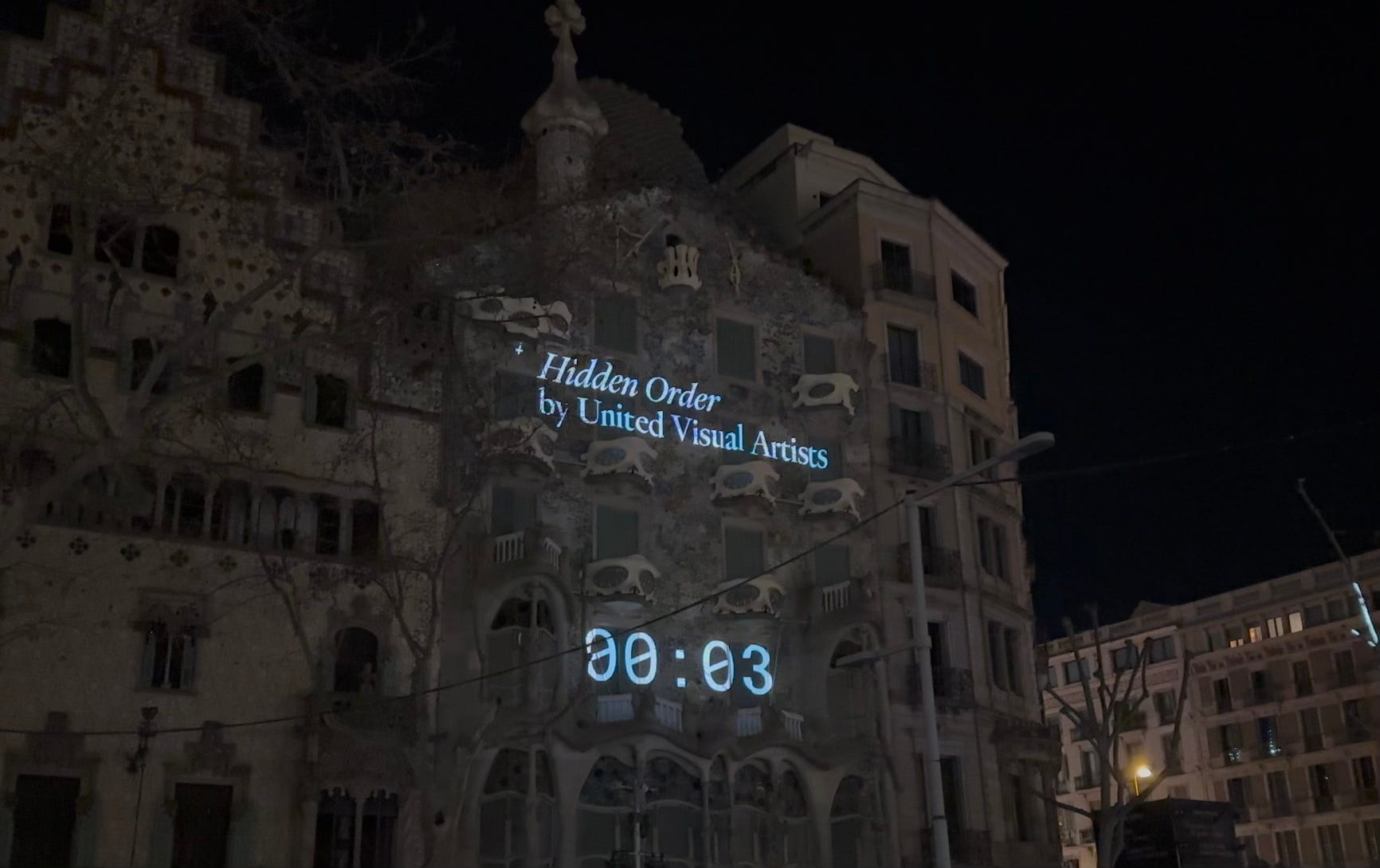
Barcelona: Experiencing Hidden Order at Casa Batlló
The 2026 Gaudí Year Mapping Event
Last night I found myself standing amidst a sea of upturned faces on the Passeig de Gràcia, breath visible in the cool January air, waiting for the facade of Casa Batlló to wake up. It was the premiere of Hidden Order, a digital mapping spectacle by United Visual Artists, and the anticipation in the crowd was electric. As the first major event of the Gaudí Year 2026, marking the centenary of the architect’s death, it felt less like a light show and more like a séance summoning the spirit of the building itself.
The darkness fell and the familiar bone-like balconies and dragon-scale roof faded into silhouette before being vividly reconstructed by light. What struck me immediately was the contrast. Gaudí is celebrated for his organic, fluid forms, yet Matt Clark and his studio chose to explore the geometry and mathematical laws that govern that apparent chaos. It was a fascinating dialogue between the digital and the natural.
The most captivating moment was seeing the human element merge with the stone. They had motion-captured the dancer Fukiko Takase, and her movements were projected across the undulating walls. It gave the impression that the building was breathing, stretching, and dancing along with us. The accompanying soundscape wrapped around us, vibrating through the pavement, grounding the ethereal visuals in something physically felt.
For eleven minutes, the usual bustle of the city suspended itself. We were all just watching this “hidden order” reveal itself—a reminder that beneath the complex, swirling beauty of Gaudí’s work, there is a rigorous, calculated structure derived from nature. It was a humbling start to a year of celebration here in this vibrant city.
As the lights faded and the applause rippled through the crowd, I walked away feeling that I had seen the building not just as a monument, but as a living entity. It was a perfect winter evening in Catalan culture, celebrating art in the heart of Catalunya, Spain.


Fascinating how mapping tech exposed the rigour under what looks so spontaneous. That detail about motion-capturing Fukiko Takase and projecting her onto the walls is so clever, makes the whole facade feel alive. Saw similar projections in Tokyo once and the way it shifts perception of static architecture is kinda wild.