Roses and Readers - the Heart of Sant Jordi in Barcelona
Discover the Legend and Literary Spirit of Catalonia’s Most Beloved Tradition
Waking up in Barcelona on April 23 feels different from any other morning in the city. The air carries a distinct perfume of thousands of fresh roses and the crisp scent of new paper. This is the feast of Sant Jordi, and it is arguably the most beautiful day to be in Catalonia. Unlike typical holidays where shops close and the city goes quiet, today the streets are more alive than ever.
As I navigate the crowded walkways of the Rambla and the wide boulevards of Passeig de Gracia, I am surrounded by a sea of red flowers and stacks of books. This unique celebration is often called the Catalan Valentine’s Day, but it feels much more communal and culturally deep. The tradition stems from a mix of ancient legend and a love for literature. History tells of Sant Jordi, a brave knight who saved a princess by slaying a terrifying dragon. Legend says that from the blood of the fallen beast, a rose bush sprouted with the most beautiful red flowers ever seen. The knight plucked one and gifted it to the princess as a symbol of his protection and devotion.
For centuries, this romantic gesture defined the day, but in the early 20th century, a new tradition was woven into the fabric of the holiday. In 1923, a local bookseller decided to commemorate the deaths of two literary giants, Miguel de Cervantes and William Shakespeare, who both passed away around this date. This transformed the day into a massive celebration of the written word. Now the custom is for loved ones to exchange roses and books. It is a spectacular sight to see children, parents and couples all clutching a single long-stemmed rose, often wrapped with a sprig of wheat and a small red and yellow ribbon representing the colours of the Senyera.
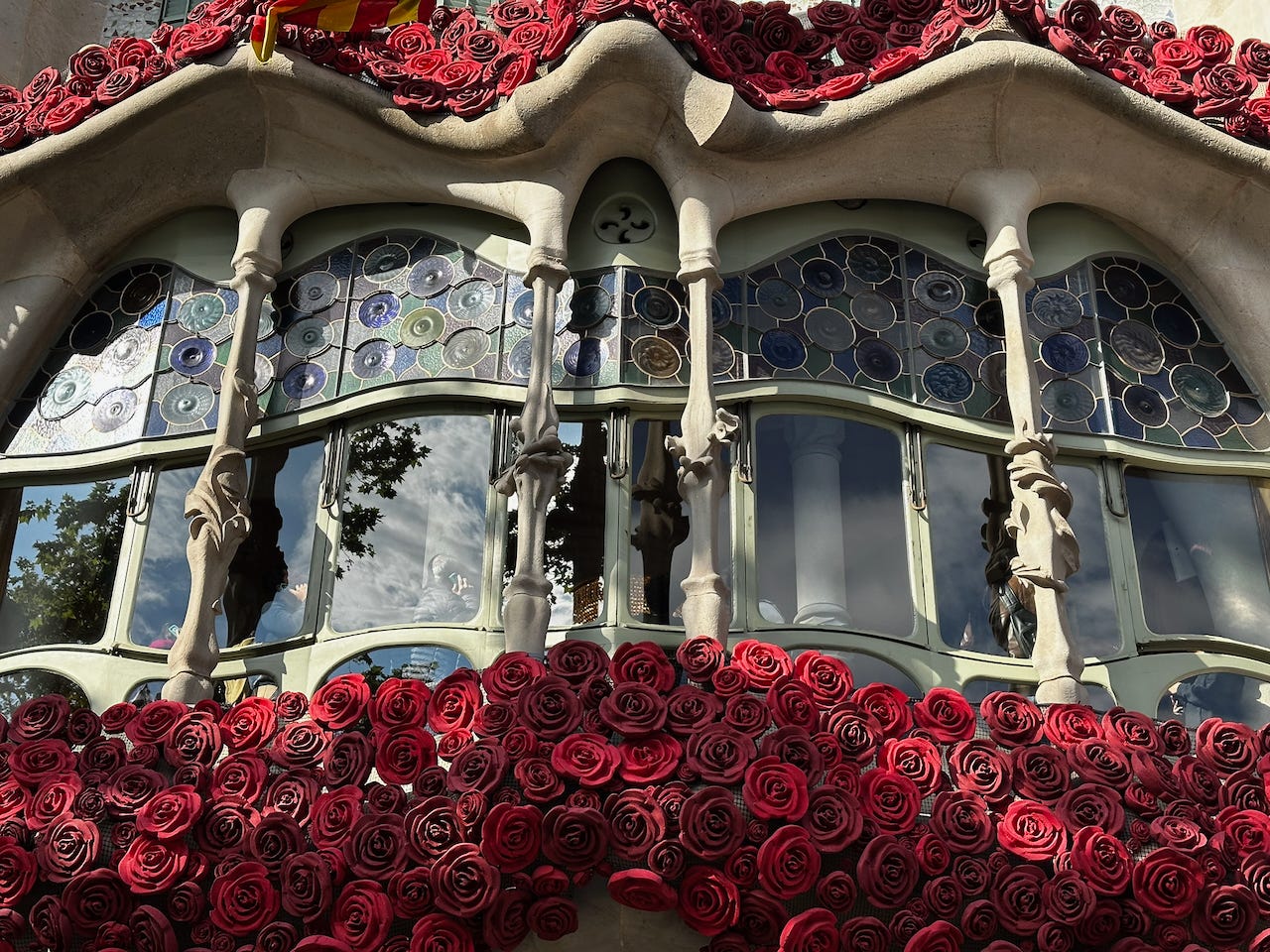
Walking through the city centre, I notice how the architecture itself seems to participate in the festival. The Casa Batlló, designed by Antoni Gaudí, is famously inspired by the legend of Sant Jordi. The roof looks like the scaly back of a dragon, and on this day, the balconies are overflowing with red roses, making the building look as though it is blooming. It is a reminder of how deeply this story is embedded in the identity of the people here.
Food also plays a starring role in the festivities. I stopped at a local bakery to try the Pa de Sant Jordi. This is a savoury bread that uses layers of sobrassada and cheese to create the red and yellow stripes of the Catalan flag when sliced. It is the perfect snack to carry while browsing the endless book stalls. Every plaza is filled with authors signing their latest works, and the energy is infectious. There is no sense of commercial pressure, just a genuine collective appreciation for culture and storytelling.
As the sun sets over the Mediterranean, the city remains vibrant. People are still out sharing stories and holding their new treasures. To be here on this day is to witness a culture that truly values its history and its artists. It is a day when the dragon is defeated, not with a sword but with the beauty of a flower and the power of a book.