Sant Just i Pastor and the Hidden History of the Gothic Quarter
The Oldest Church in Barcelona
In Barcelona, history rarely announces itself with grandeur. It hides instead in courtyards, behind unassuming façades, in squares that tourists cross without knowing their names. The Basílica dels Sants Màrtirs Just i Pastor belongs to this quieter category of monuments: a church that does not dominate the skyline, does not compete with the Cathedral, and does not plead for attention. And yet, few buildings in the city have witnessed as much history unfold. Tucked into Plaça de Sant Just, in the dense and almost claustrophobic weave of the Gothic Quarter, the basilica stands where centuries overlap like half-erased sentences on parchment. It is traditionally cited as the oldest church in Barcelona, not because its present stones are the oldest, but because this site has been sacred longer than the city has remembered itself clearly. What rises today is Gothic, but what lies beneath is Roman, Visigothic, Carolingian, medieval, and modern—each era leaving behind fragments, scars, and quiet testimony. To encounter Sant Just i Pastor by chance is to encounter Barcelona stripped of spectacle. There are no long queues, no explanatory panels shouting significance, no sense of obligation to admire. There is only a small square, a fountain murmuring steadily, a bell tower reaching upward without urgency, and a feeling—difficult to articulate—that something very old is still breathing here.
The story of Sant Just i Pastor does not begin with its current walls. It begins with the idea of permanence itself. Archaeological excavations have confirmed that the basilica stands on a site of worship dating back to at least the fourth century, when Barcino was still a Roman colony poised between empire and periphery. Christianity, once marginal and persecuted, was becoming institutional, architectural, and visible. The remains of a Roman column discovered beneath the church are not merely reused material; they are evidence that sacred space was being redefined rather than erased.
By the sixth century, during Visigothic rule, the site had gained enough importance to warrant the construction of a baptistery. This detail is significant. Baptisteries were not added casually to churches; they marked places of communal authority, initiation, and continuity. The fragments uncovered beneath Sant Just i Pastor suggest that the site had already become a focal point of Christian life in the city long before Barcelona had a coherent urban identity.
Even the Muslim conquest of the Iberian Peninsula in the eighth century did not entirely sever the memory of this sacred place. When the Franks reconquered Barcelona in 801 under Louis the Pious, son of Charlemagne, the church appears again in written records, explicitly mentioned and formally restored. This moment signals more than a political transition. It represents the reassertion of Christian institutions under Carolingian rule and the deliberate rebuilding of a religious landscape meant to stabilise power, faith, and community.
For centuries afterwards, a Romanesque church occupied the site. It stood quietly through growth and decline, prosperity and uncertainty, until it was eventually deemed insufficient for a medieval Barcelona that had outgrown its earlier scale. The decision to rebuild was not merely practical; it was aspirational. Construction of the current Gothic structure began on February 1, 1342, at a moment when the city stood near the height of its economic and maritime power.
The timing, in retrospect, feels almost cruel. Just six years later, the Black Death would tear through Barcelona, killing tens of thousands and altering the city irreversibly. The Gothic church that was meant to embody confidence and continuity would instead rise amid trauma, labour shortages, and collective grief. Its construction would stretch across more than two centuries, finally concluding around 1574. By then, the Gothic style was already fading elsewhere, making Sant Just i Pastor the last great Gothic church built in the city.
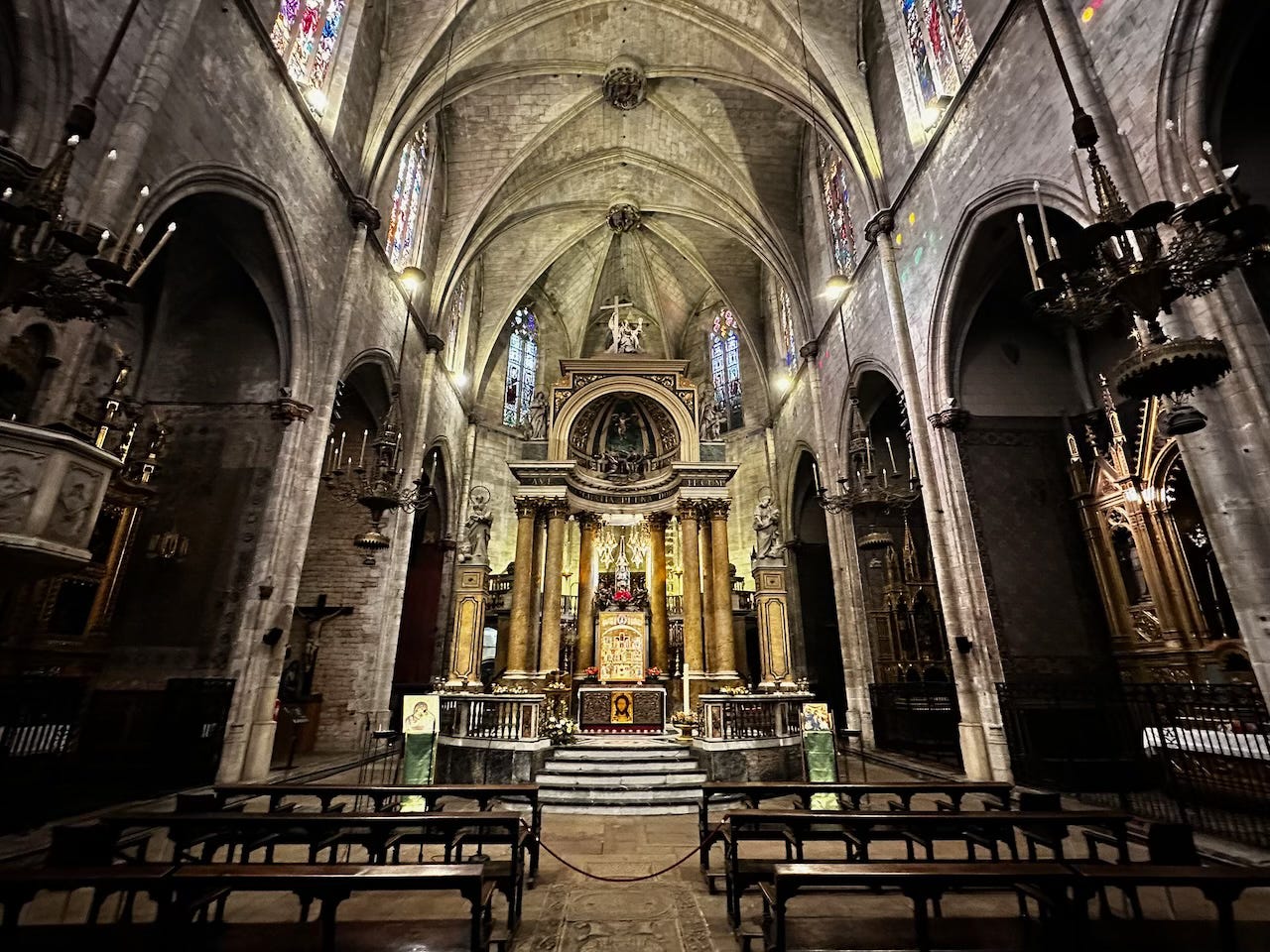
This extended construction period gives the basilica a distinctive character. It is not Gothic as a single statement, but Gothic as endurance. Catalan Gothic, unlike its northern European counterpart, does not strive for overwhelming verticality. It favours breadth, clarity, and spatial unity. Sant Just i Pastor reflects this sensibility perfectly, offering an interior that feels measured rather than monumental, contemplative rather than theatrical.
From the outside, the church is almost deliberately modest. The façade is simple and restrained, a reflection of a broader Catalan tendency to invest artistic energy inward rather than outward. The stone exterior communicates solidity and permanence without ornamentation, as though the building expects to be approached slowly, without instruction.
The most striking external feature is the bell tower. Rising thirty-five meters above the square, semi-octagonal in form and visibly incomplete, it speaks less of triumph than of interrupted ambition. Built across the fifteenth and sixteenth centuries, the tower bears the imprint of multiple master builders, including Pere Blai, linking it to a broader lineage of Catalan architectural practice. Its unfinished state is not an anomaly but a historical truth, shaped by shifting priorities, resources, and tastes.
Climbing the bell tower is a physical negotiation with history. The staircase is narrow, steep, and unyielding, offering no comfort and no spectacle until the very end. At the top, the reward is not a panoramic vista but an intimate geography. The rooftops of the Gothic Quarter press in closely, the Cathedral rises with quiet authority nearby, and Santa Maria del Mar anchors the distance. It is a view that reveals Barcelona as a dense accumulation of lives rather than a city of isolated landmarks. Inside, the basilica opens into a space defined by unity. The single-nave layout draws the eye forward toward the polygonal apse, uninterrupted and calm. Six rectangular chapels line the nave, set between buttresses in a steady rhythm that feels both structural and ceremonial. Nothing competes for attention; everything belongs.
The nave is covered by cross-vaulting, its keystones decorated in polychrome depictions of scenes from the life of the Virgin Mary. These painted elements serve as narrative anchors, reminding visitors that Gothic architecture was as much about storytelling as it was about engineering. Light enters through fifteenth-century stained glass windows set high in the clerestory, filtering down in muted tones that create a sanctified gloom. The light does not flood the space; it inhabits it, encouraging stillness rather than awe.
Despite centuries of upheaval, the basilica preserves important artistic works. The most significant is the Altarpiece of the Passion, located in the Chapel of Sant Feliu. Painted between 1525 and 1530 by the Portuguese artist Pere Nunyes, it stands as one of the finest examples of Renaissance painting in Catalonia. The work depicts the suffering of Christ with emotional intensity and careful composition, blending human vulnerability with theological gravity. It marks a transition from medieval symbolism toward Renaissance humanism, without abandoning devotional purpose.
The main altar, by contrast, reflects a later aesthetic shift. Constructed between 1816 and 1832, it is neoclassical in style, featuring six monolithic marble columns arranged in a hemicycle. It replaced an earlier Renaissance altar, signalling the changing artistic values of post-Enlightenment Barcelona. Behind it stands a replica of the Virgin of Montserrat, La Moreneta. According to legend, the original image was hidden in Sant Just i Pastor during the Moorish invasion to protect it from destruction. Whether historical fact or devotional myth, the story reinforces the church’s role as a refuge in moments of uncertainty.
Beneath the basilica lies one of its most sobering chapters. Archaeological excavations uncovered a mass grave containing approximately one hundred and twenty bodies, victims of the Black Death that struck Barcelona in 1348. These were people who lived and died as the Gothic church was rising above them. Builders, parishioners, families—all absorbed into the foundations. The discovery collapses the distance between monument and mortality, reminding us that churches were not only places of worship, but also sites of burial, refuge, and communal grief.
Just outside the entrance stands the Font de Sant Just, one of the oldest Gothic fountains in Barcelona. Commissioned in 1367, though sometimes dated to 1427, it reflects the intersection of civic life, devotion, and legend. The fountain is traditionally attributed to Joan Fivaller, a nobleman said to have discovered a spring while hunting in the Collserola mountains and financed an aqueduct to bring water to the square during a severe drought. Whether embellished or not, the story situates the church within the daily survival of the city, transforming infrastructure into memory. Three stone masks spout water beneath a relief of Sant Just and the Fivaller coat of arms, where utility becomes narrative.
Today, Sant Just i Pastor continues to evolve without abandoning its past. Its acoustics make it a favoured venue for classical music concerts, where sound interacts with stone in ways medieval builders could never have predicted. The square and church have also appeared on screen, most notably in the 2006 film Perfume: The Story of a Murderer, where they stood in for eighteenth-century France. Cinema, like religion before it, recognises the atmospheric power of this place.
Sant Just i Pastor does not shout its importance. It waits. It teaches that history is not always monumental; sometimes it is persistent. That faith can be architectural, but also archaeological. That a city’s deepest stories are often told not by its most famous buildings, but by those that endured quietly. Stone was laid over plague victims. Gothic arches rising from Roman foundations. A bell tower unfinished, yet still standing. To stumble upon this basilica is to stumble upon Barcelona itself—not the city of postcards and crowds, but the city of layers, absences, and survival. Sant Just i Pastor is not merely the oldest church in Barcelona. It is one of its most honest.